

Every year, RUB welcomes around 600 new international students. They often face particular challenges. One of these students is Negar. She came to RUB from Iran two years ago. She explains that, at the start, language was especially challenging for her:

“The biggest problem was the language because nobody warned us it`s gonna be this hard to not speak german. Everything was in german and when you don`t know any german it`s super hard to integrate.“
Even having just a little grasp of the language already makes a difference, she says. The language barrier surprised her in particular because, like many other international students, she studies entirely in English. However, RUB, despite being an international university, is still organized predominantly in German in general areas such as the mensa or the housing management.
For reasons like these, there's the International Office, the central point of contact for international students at RUB. Jutta Schmid, the head of the International Office, told us in an interview about similar problems faced by many international students. Especially at the start of their studies, there are various offerings available for new students.
Negar herself attended several of these. It particularly helped her get to know other students. One offer was an online program called "Getting to know the University". With the other participants, she created a WhatsApp group that quickly became a helpful, steady community. There, they exchanged thoughts on open questions early on.
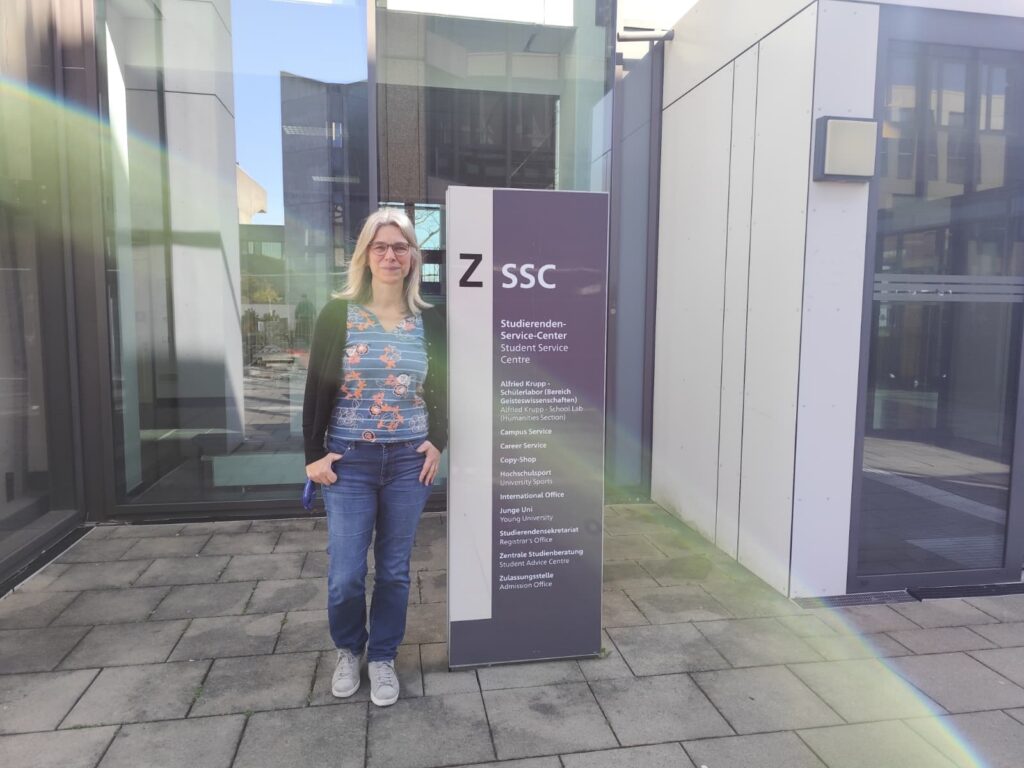
But what if problems start even before the studies begin? The International Office has resources for that too. The RUB International Student Services offer consultation hours – both online and in person. There, in addition to questions about organizing one's studies, questions about arrival, visas, apartment search, and similar topics can also be addressed. The International Office doesn't just work campus-wide, though – it also cooperates with the city of Bochum. According to Jutta Schmid, there's also a "fairly direct line" to the immigration office (Ausländerbehörde).
Besides the International Office, there are other ways for international students to find connections. Negar reports: “I requested how I could join AStA [General Students' Committee] and I got to know the student parliament [StuPa] by that. So I got to know a lot of germans.“
The AStA and especially the Erasmus Student Network (ESN) helped her make connections early on. Even before university started, she volunteered with ESN, which supports students from other countries as they start at the university. It's designed to enable good connections and community and organizes various events for that purpose. The Sprachcafé (language café), a meeting point for exchange and games at different language tables, also helped her get to know people.
Above all, though, Negar wants to give international students one central piece of advice: “Try to make friends here with everything that you can do. At events you should go and try to talk to people and make friends. Because you don’t know and you don’t think it’s gonna be super lonely sometimes.“
Jutta Schmid echoes this: "On one hand, it's important to actively look for friendships. You should attend orientation events. The faculties and degree programs also offer their own orientation programs, and we strongly encourage taking advantage of these opportunities early on. There you meet others who are also new—including students from the region." She says it's usually easiest to find connections within these groups.
The moments of loneliness Negar describes are feelings that many international students struggle with – whether triggered by frustration over the language, general overwhelm, or fear of a completely new life situation. But there's support available for this too, as Jutta Schmid notes:
"We work closely with the psychological counseling service for students, because we're seeing more and more cases where mental health plays a role. It's about the question of how someone is coping with the new situation overall, and whether they need a different kind of support than just information – maybe a counseling conversation."
Anyone who experiences discrimination, on the other hand, can turn to Michalina Trompeta, the officer for diversity and anti-discrimination at RUB.
However, it should be in the interest of all students to create an environment early on in which everyone feels comfortable and welcomed. There are various ways to do this: whether through getting involved with institutions like the International Office, or simply within one's personal circle. It can already help to approach new people, offer them help, start a short conversation, or have the courage to build closer connections.
Negar herself says: “Knowing one person to just have a coffee with is gonna change everything.”
Disclaimer: Parts of this article were translated by Claude AI.